
Generative Engine Optimization (GEO): The Complete Guide to AI Search Visibility in 2026
 Author
  Published on:
  Read Time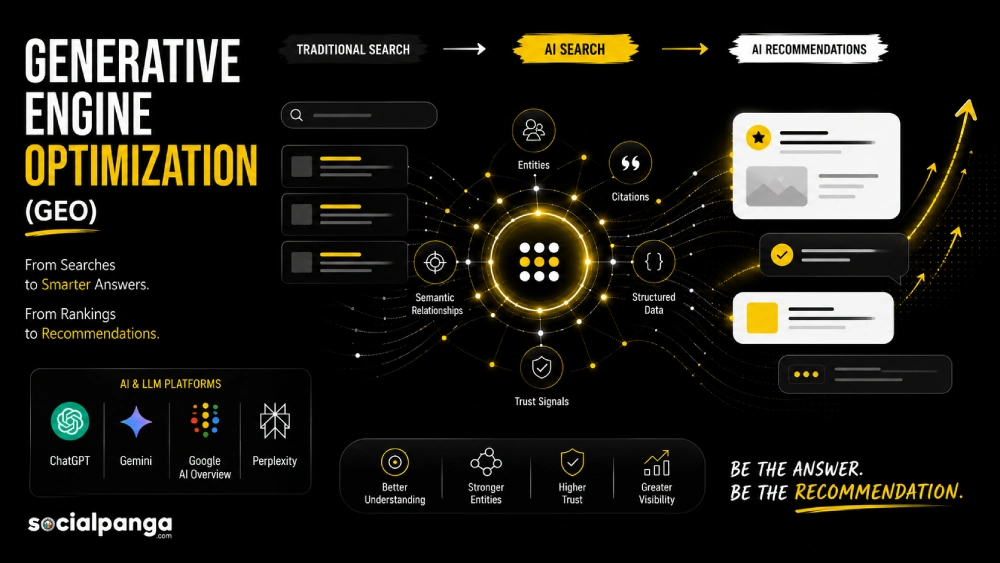
Quick Summary
- Generative Engine Optimization (GEO) is the next evolution of SEO, helping brands improve their visibility across AI-powered platforms like ChatGPT, Gemini, Perplexity, and Google AI Overviews.
- As search shifts from blue links to AI-generated answers, businesses need to focus on authority, trust, and AI-friendly content, not just rankings.
- This guide explains the differences between SEO, AEO, LLMO, and GEO, along with practical strategies to optimize your brand for AI search.
- Learn how to create AI-friendly content, build topical authority, leverage E-E-A-T principles, and measure GEO success using actionable KPIs.
- Whether you’re a marketer, founder, or business owner, this guide provides a practical roadmap to prepare your brand for the future of AI-driven search.
Introduction
For years, digital marketing & SEO revolved around one goal: ranking on Google.
Businesses invested in SEO, created blogs, built backlinks, and optimized websites to appear on the first page of search results. The higher you ranked, the more traffic you received.
But search is changing rapidly.
The shift towards AI-powered search isn’t a future prediction – it’s already happening.
Google’s AI Overviews reached more than 1.5 billion monthly users across 200+ countries in 2025, making it one of Google’s fastest-growing search experiences. (Source: Google I/O 2025 Keynote)
ChatGPT processes billions of prompts every day, reflecting a major shift in how users discover information, compare products, and make purchase decisions. (Source: Open AI Disclosure)
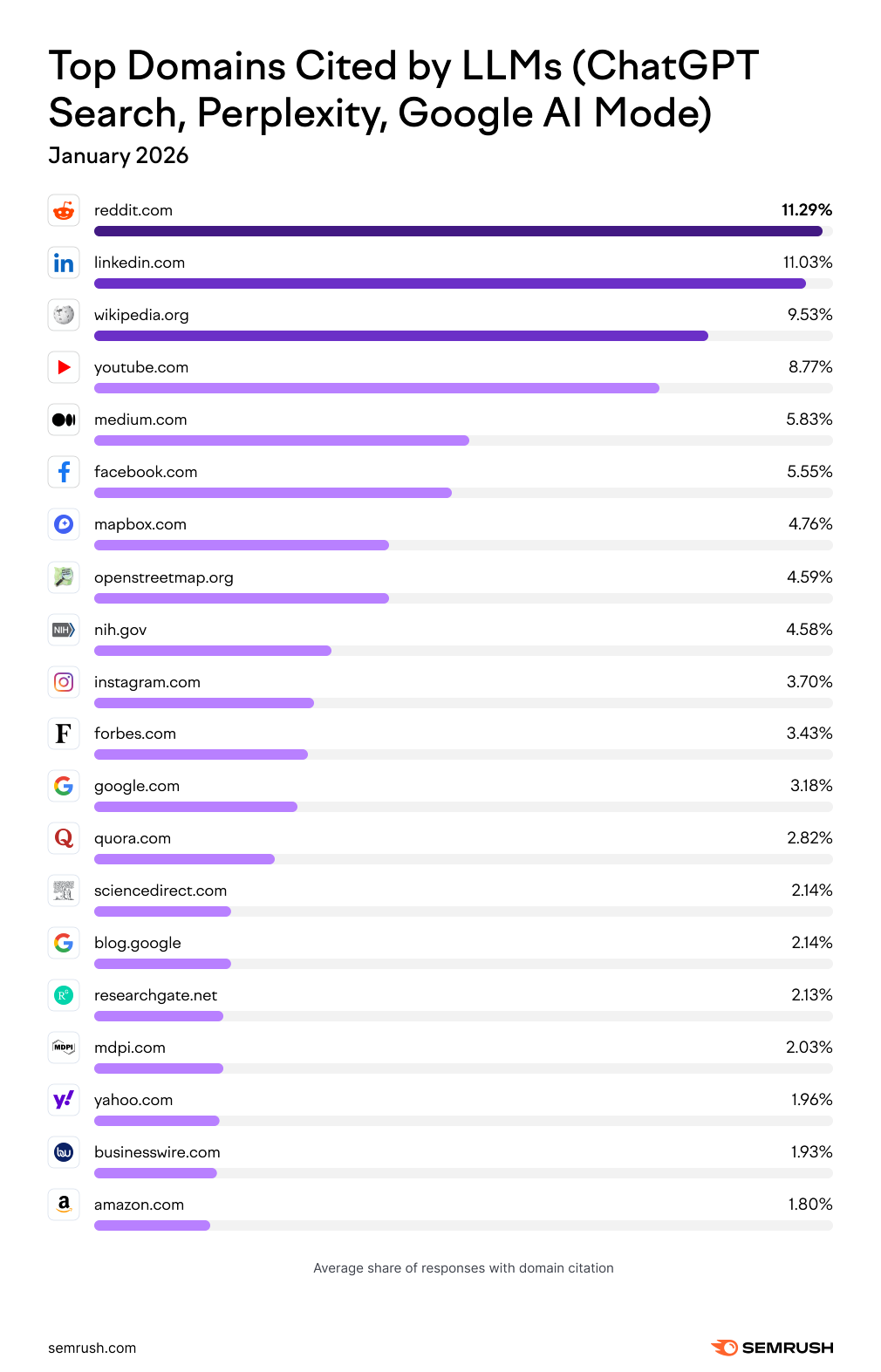
Today, millions of users don’t just search on Google – they ask questions directly to AI platforms like ChatGPT, Gemini, Claude, Perplexity, and Google’s AI Overviews.
Instead of browsing through multiple websites, users receive a summarized answer within seconds.
For businesses, this changes an important question.
It’s no longer just:
“Does my website rank on Google?”
It’s also:
“Does AI recommend my brand when users ask relevant questions?”
That’s exactly where Generative Engine Optimization (GEO) comes in.
In this guide, we will explain what GEO is, how it differs from traditional SEO, why it matters for modern businesses, and the practical steps you can take to improve your visibility in AI-generated answers.
What is Generative Engine Optimization (GEO)?
Generative Engine Optimization (GEO) is the practice of optimizing your website, content, and overall digital presence so that AI-powered search engines and assistants can discover, understand, and reference your brand in their responses.
Unlike traditional SEO, which focuses on improving rankings on search engine results pages (SERPs), GEO focuses on increasing your chances of being:
- Mentioned in AI-generated answers
- Cited as a trusted source
- Recommended during product comparisons
- Referenced in conversational searches
For example, if someone asks:
“Which is the best project management software for my startup”
An AI assistant may summarize information from multiple trusted sources and recommend only a few softwares.
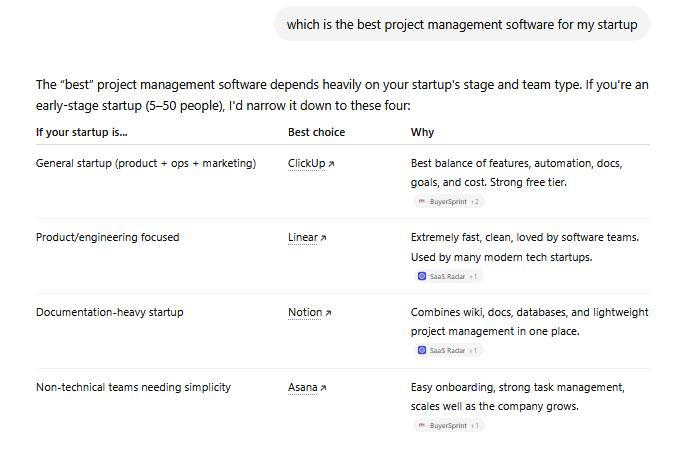
The goal of GEO is to increase the likelihood that your business becomes one of those recommendations.
Why GEO Matters More Than Ever
AI is changing how people discover information online.
Instead of typing short keywords like:
- best CRM
- SEO agency
- accounting software
Users are asking complete questions such as:
- Which CRM is best for small businesses?
- How do I improve my website’s organic traffic?
- Which accounting software is suitable for Indian MSMEs?
AI assistants provide direct answers, often reducing the need to visit multiple websites.
This creates a major shift in digital marketing:
- Less emphasis on clicks alone
- Greater importance of recommendations
- Increased focus on authority and trust
- Growing competition for AI visibility
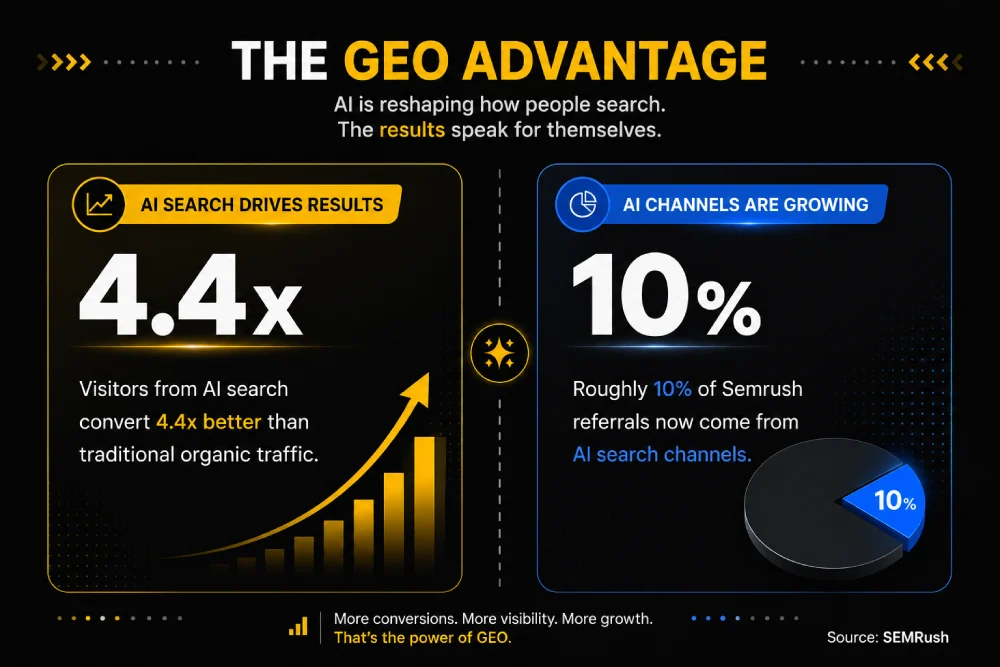
The numbers tell a clear story: AI-driven discovery is no longer a future trend, it’s already influencing traffic, conversions, and brand visibility. Businesses that adapt early can build stronger visibility across both traditional search engines and AI-powered search experiences.
The Evolution of Search: From Blue Links to AI Answers
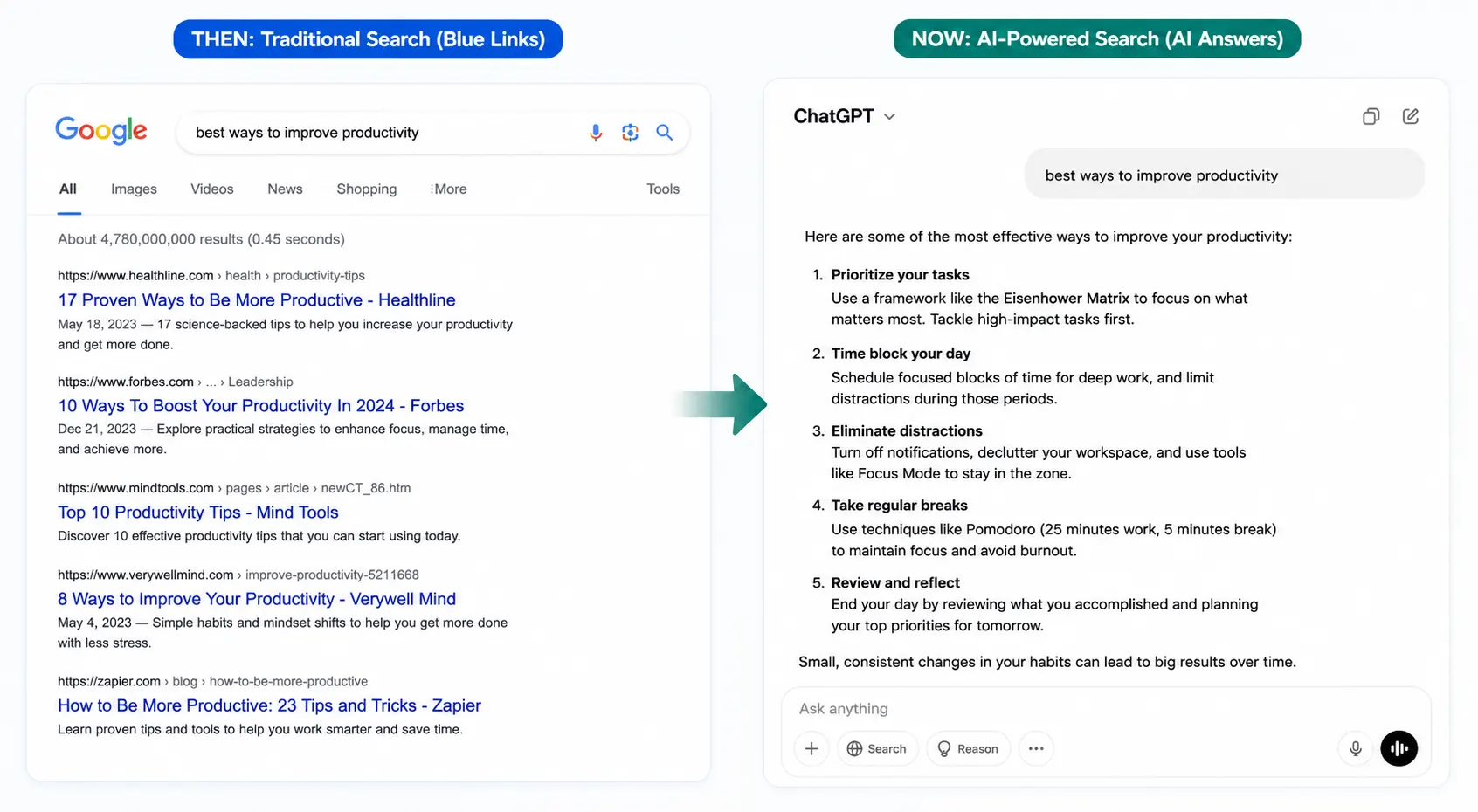
Search has changed dramatically over the last two decades.
There was a time when users typed a few keywords into Google, browsed through multiple websites, compared information, and made a decision. Businesses focused almost entirely on improving their rankings because visibility on the first page meant more traffic and potential customers.
Today, the journey looks very different.
Users are increasingly asking complete questions to AI assistants like ChatGPT, Gemini, Claude, and Perplexity instead of performing traditional searches. Rather than displaying a list of links, these platforms generate a summarized answer by combining information from multiple trusted sources.
For example, instead of searching for:
“best CRM software India”
A user might ask:
“I’m running a 20-person startup in India with a limited budget. Which CRM software would you recommend and why?”
The AI doesn’t simply provide links – it evaluates available information and offers a recommendation.
This shift has significant implications for businesses. Success is no longer measured only by search rankings but also by whether AI systems recognize and recommend your brand.
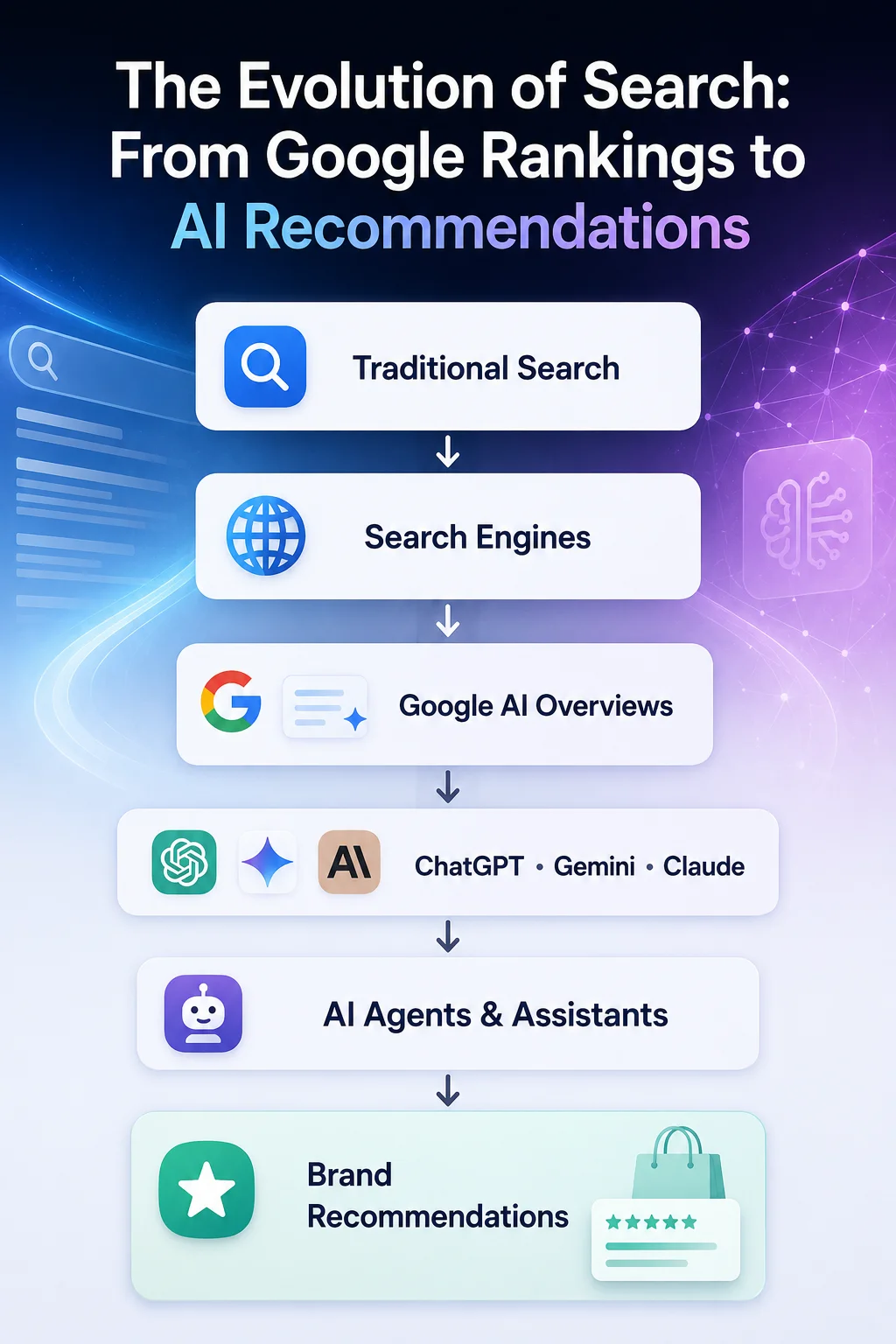
The Search Evolution Timeline
- Traditional Search: Users searched using keywords and clicked websites.
- Semantic Search: Search engines became better at understanding user intent.
- Mobile & Voice Search: Conversational queries became more common.
- AI Overviews: Search engines started answering questions directly.
- Conversational AI: ChatGPT, Gemini, Claude, and Perplexity changed how users discover information.
- AI Agents: The next generation of AI will not only answer questions but also assist with research, shopping, planning, and purchasing decisions.
For marketers, this means that optimization strategies must evolve alongside user behaviour.
GEO vs SEO vs AEO vs LLMO
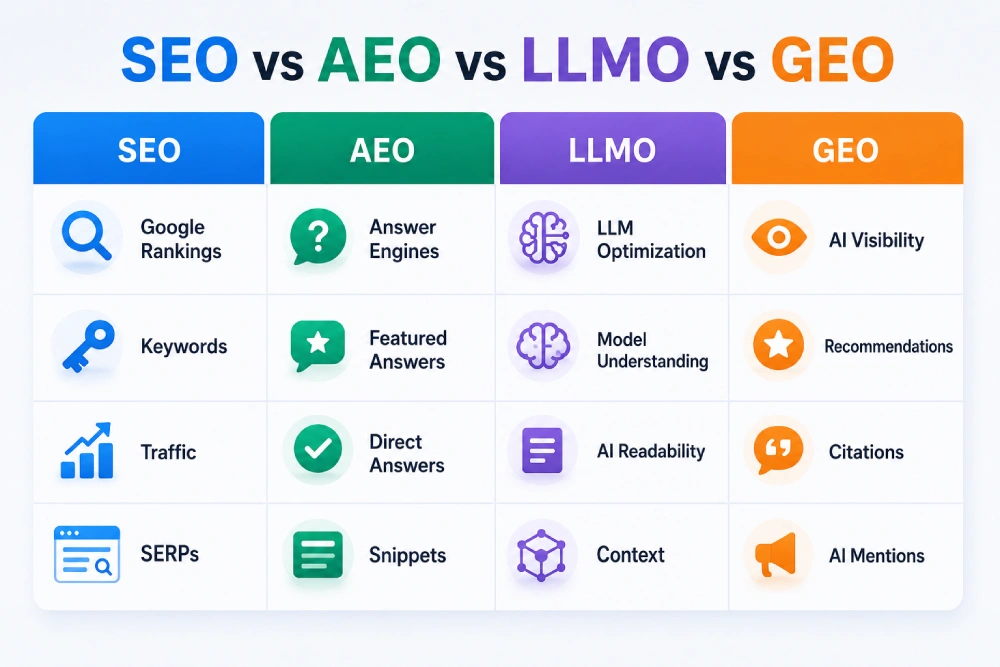
As AI-powered search continues to evolve, several new optimization terms have emerged. While they are closely related, each focuses on a different aspect of search visibility.
Search Engine Optimization (SEO)
SEO is the practice of improving your website’s visibility in traditional search engines like Google and Bing. It focuses on technical optimization, content quality, backlinks, and keyword relevance to improve rankings and drive organic traffic.
Primary goal: Rank higher in search engine results.
Answer Engine Optimization (AEO)
AEO focuses on helping content appear as direct answers in search experiences such as featured snippets, voice assistants, and AI-generated answer boxes.
It emphasizes concise answers, FAQs, structured data, and question-based content.
Primary goal: Become the preferred answer to user queries.
Large Language Model Optimization (LLMO)
LLMO refers to optimizing content so that large language models can better understand, interpret, and reference it.
This includes improving content clarity, context, factual accuracy, semantic relationships, and machine readability.
Primary goal: Improve understanding by AI models.
Generative Engine Optimization (GEO)
GEO is a broader discipline focused on increasing a brand’s visibility across AI-powered search experiences and generative engines.
It combines elements of SEO, AEO, entity optimization, digital PR, topical authority, and brand reputation to improve the likelihood of being cited or recommended by AI systems.
Primary goal: Increase AI visibility, citations, and recommendations.
| Aspect | SEO (Search Engine Optimization) | AEO (Answer Engine Optimization) | LLMO (Large Language Model Optimization) | GEO (Generative Engine Optimization) |
| Primary Goal | Rank higher in search engines | Become the direct answer to user queries | Help LLMs understand and process content | Increase visibility and recommendations in AI-generated responses |
| Optimizes For | Google, Bing, and other search engines | Featured snippets, voice search, answer engines | Large Language Models like ChatGPT and Gemini | AI-powered search and generative engines |
| Focus Area | Rankings and organic traffic | Answering user questions clearly | Machine-readable, context-rich content | AI citations, mentions, and brand recommendations |
| Key Elements | Keywords, backlinks, technical SEO, content | FAQs, concise answers, structured data | Semantic context, entities, factual clarity | SEO + entities + authority + brand reputation + AI-friendly content |
| Success Metric | SERP rankings and website traffic | Featured snippets and answer visibility | Better AI understanding and retrieval | AI mentions, citations, share of voice, and recommendations |
| Content Style | Keyword-focused and user-centric | Question-answer format with direct responses | Contextual, structured, and factually accurate | Comprehensive, authoritative, and easy for AI to extract and cite |
| Importance of Brand Authority | High | High | High | Critical |
| Role of Structured Data | Recommended | Very Important | Helpful | Highly Recommended |
| Typical Example | Ranking #1 for “Best CRM Software” | Appearing in Google’s featured snippet for “What is a CRM?” | AI accurately understanding your CRM features and use cases | ChatGPT or Gemini recommending your CRM when a user asks for the best options |
The Bottom Line
Think of GEO as an evolution rather than a replacement.
Strong SEO builds discoverability.
AEO improves direct answers.
LLMO improves machine understanding.
GEO combines all of these elements to maximize visibility in the age of AI-powered search.
It’s important to understand that GEO isn’t a replacement for SEO, AEO, or LLMO. Instead, it builds on all three. Businesses with strong technical SEO, clear content, authoritative brand signals, and a consistent digital presence are more likely to be discovered, understood, and recommended by AI-powered search experiences.
How AI Search Works
Think of AI search as a research assistant.
When you ask a question, the AI may:
- understand your intent
- retrieve information from trusted sources
- compare multiple viewpoints
- summarize the findings
- generate a conversational answer
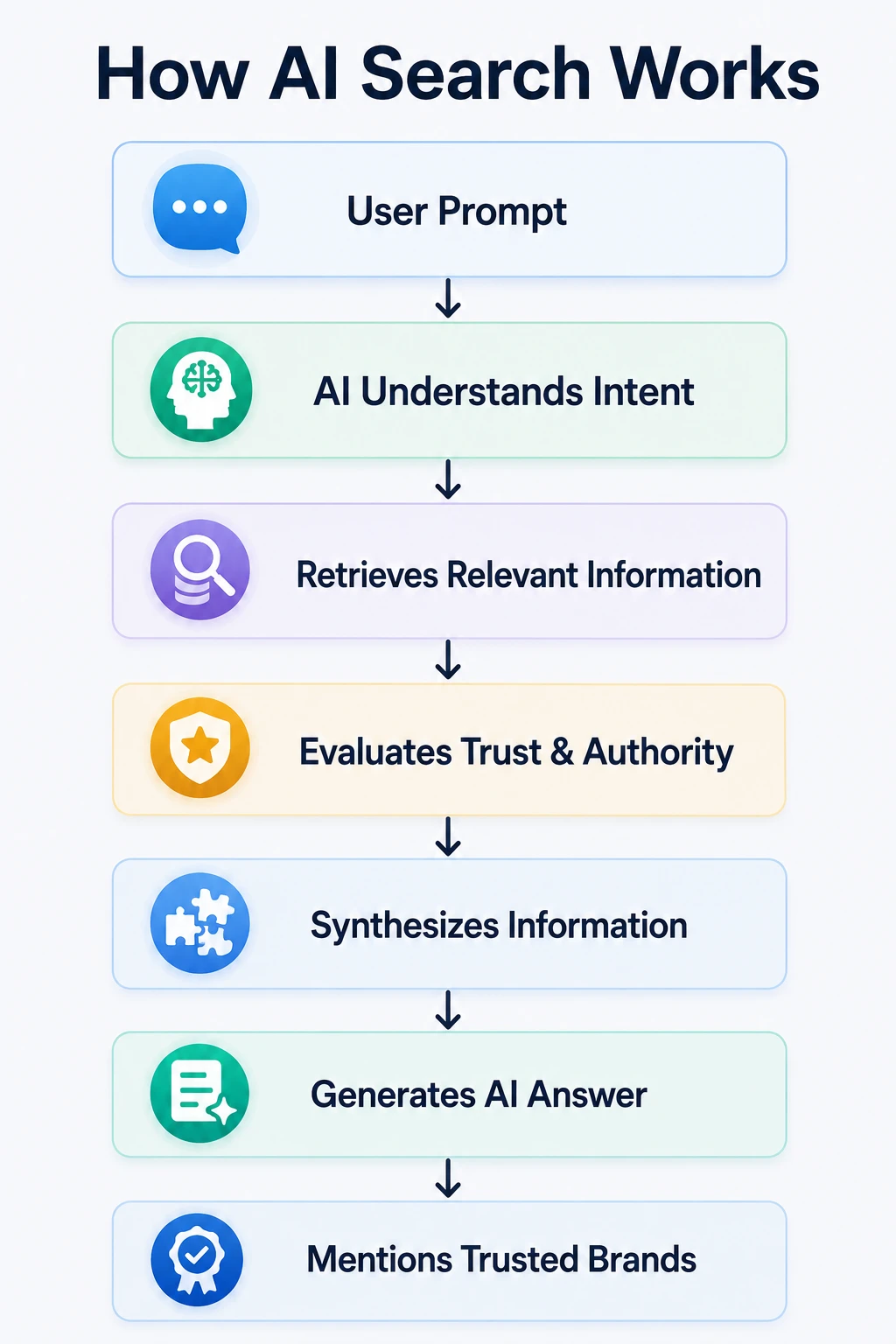
Unlike traditional search engines that simply list links, AI attempts to provide the answer itself.
This means content that is:
- easy to understand
- well structured
- factually accurate
- trustworthy
has a better chance of being referenced.
8 Practical Ways to Improve Your GEO
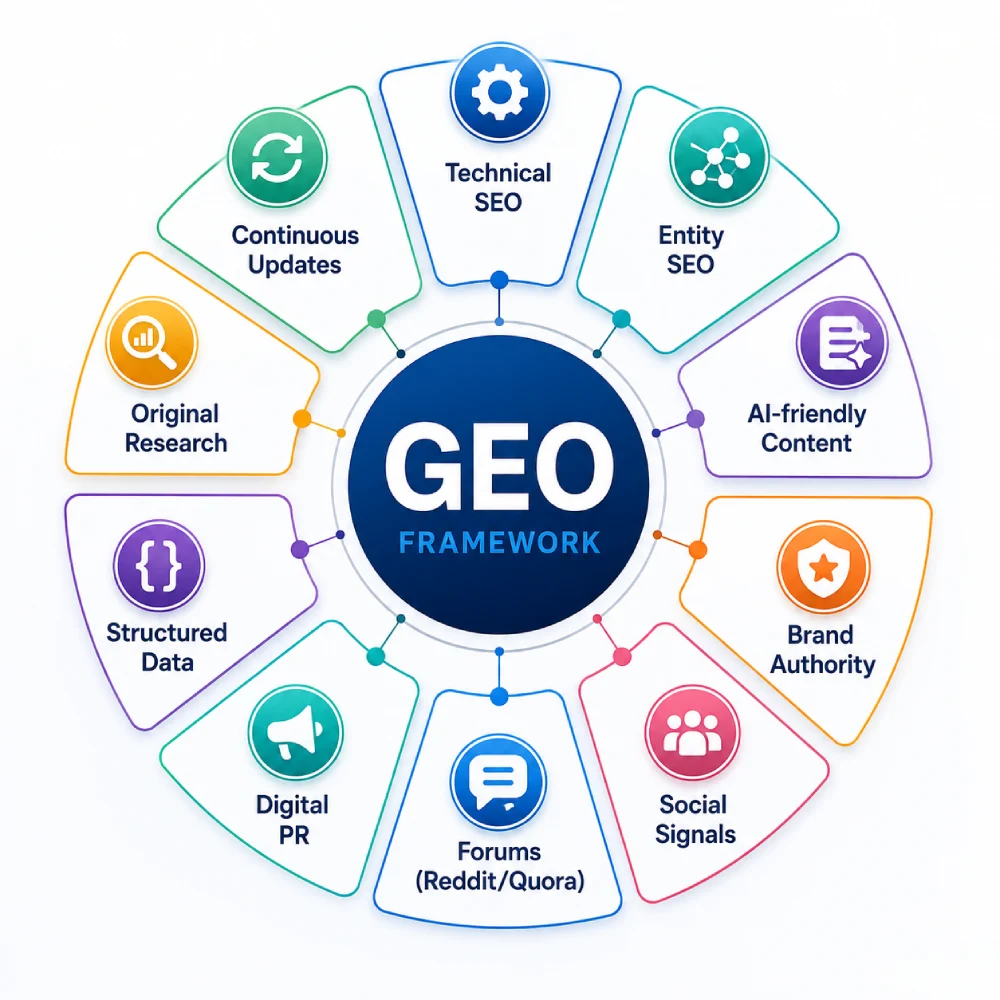
1. Build Strong SEO Foundations
Before thinking about GEO, ensure your SEO basics are in place.
Focus on:
- crawlability
- indexability
- mobile friendliness
- Core Web Vitals
- page speed
- internal linking
- technical health
AI systems still rely heavily on accessible and trustworthy websites.
2. Create Content That AI Can Easily Understand
Well-structured content is easier for both humans and AI.
Best practices include:
- descriptive headings
- short paragraphs
- bullet points
- FAQs
- comparison tables
- summaries
- direct answers
Instead of writing vague statements, explain concepts clearly and provide context.
3. Build Topical Authority
Publishing one article on a subject isn’t enough.
Become a trusted source by creating comprehensive content around related topics.
For example, instead of publishing only one SEO article, create resources around:
- Technical SEO
- Local SEO
- Enterprise SEO
- Content Marketing
- GEO
- AI Search
- Entity SEO
- Search Intent
This signals expertise and builds authority over time.
4. Make Your Brand Easy to Understand
AI should clearly know:
- who you are
- what you do
- what industry you belong to
- what products or services you offer
- what topics you’re known for
Maintain consistent messaging across:
- website
- Google Business Profile
- social media
- review sites
- industry directories
Consistency strengthens your brand identity across AI systems.
5. Build Authority Beyond Your Website
AI doesn’t only learn from your own website.
It also evaluates information available across the internet.
Important channels include:
- YouTube
- Instagram / facebook
- Quora
- News publications / PR
- Industry blogs
- Review platforms
- Podcasts
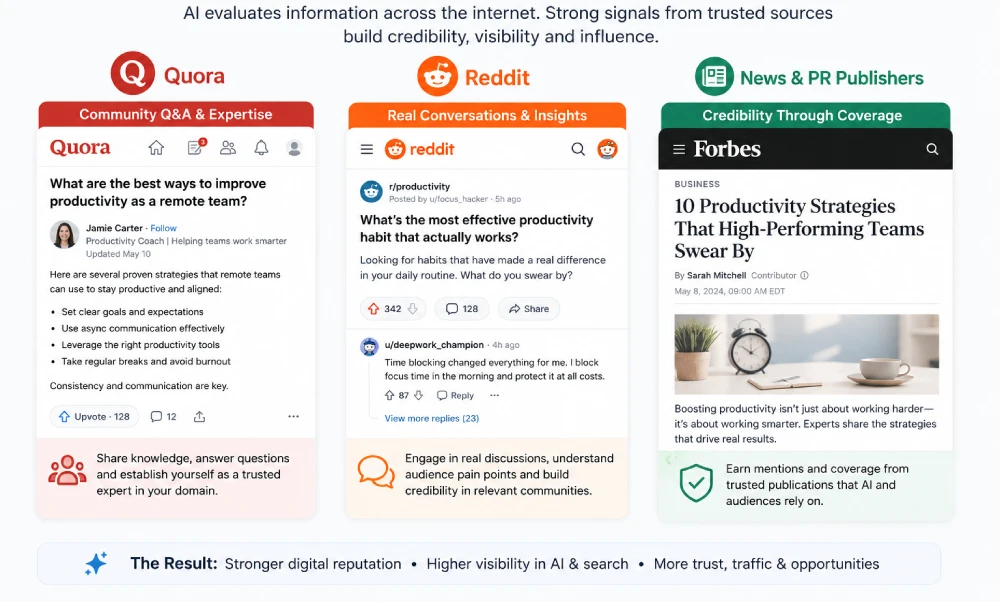
Positive discussions and credible mentions strengthen your digital reputation.
6. Publish Original Research and Insights
Unique information is more valuable than rewritten content.
Consider publishing:
- surveys
- market reports
- original statistics
- industry trends
- case studies
- customer success stories
Original data increases the chances of citations and references.
7. Use Structured Data
Schema markup helps search engines better understand your content.
Useful schema types include:
- Organization
- Article
- FAQ
- Product
- Review
- Breadcrumb
While structured data doesn’t guarantee AI citations, it improves content clarity and discoverability.
8. Keep Your Information Accurate and Updated
AI systems prefer reliable and current information.
Regularly update:
- service pages
- pricing
- company information
- author details
- statistics
- outdated articles
Fresh and accurate information improves trust signals over time.
What Type of Content Performs Best in AI Search?
Not all content is equally likely to be surfaced by AI-powered search engines. While format plays an important role, the real differentiator is how useful, credible, and trustworthy the content is.
AI systems are designed to provide users with accurate and reliable answers. As a result, they tend to favour content that is well-structured, factually correct, and demonstrates strong expertise and authority.
Content Formats That Perform Well in AI Search
The following formats are generally easier for AI systems to understand, extract, and summarize:
- Listicle articles (especially for “best”, “top”, and “recommended” queries where brand visibility matters)
- Beginner guides
- FAQs
- How-to articles
- Step-by-step tutorials
- Comparison articles
- Product roundups
- Checklists
- Glossaries
- Industry reports
- Case studies
- Original research and surveys
- Statistics and data-backed articles
However, format alone isn’t enough. A well-structured article with inaccurate or generic information is unlikely to become a trusted source for AI-generated responses.
Why E-E-A-T Matters for GEO
One of the strongest ways to improve your chances of being referenced by AI is to create content that aligns with Google’s E-E-A-T principles:
Experience
Show first-hand knowledge and practical insights rather than simply repeating information already available online.
Examples include:
- Real client case studies
- Campaign learnings
- Product demonstrations
- Personal experiences
- Original experiments
Expertise
Demonstrate subject matter knowledge through in-depth, well-researched content that genuinely answers user questions.
This can include:
- Detailed guides
- Technical explainers
- Industry insights
- Expert commentary
- Educational resources
Authoritativeness
Build your reputation as a trusted source within your industry.
Authority is strengthened through:
- High-quality backlinks
- Mentions in reputable publications
- Digital PR
- Guest articles
- Industry recognition
- Thought leadership
- Consistent topical authority
Trustworthiness
Trust is the foundation of long-term visibility in both search engines and AI-generated answers.
Build trust by:
- Citing reliable sources
- Publishing accurate information
- Displaying author credentials
- Keeping content updated
- Maintaining transparent business information
- Including customer reviews and testimonials
- Using secure, accessible websites
The GEO + E-E-A-T Formula
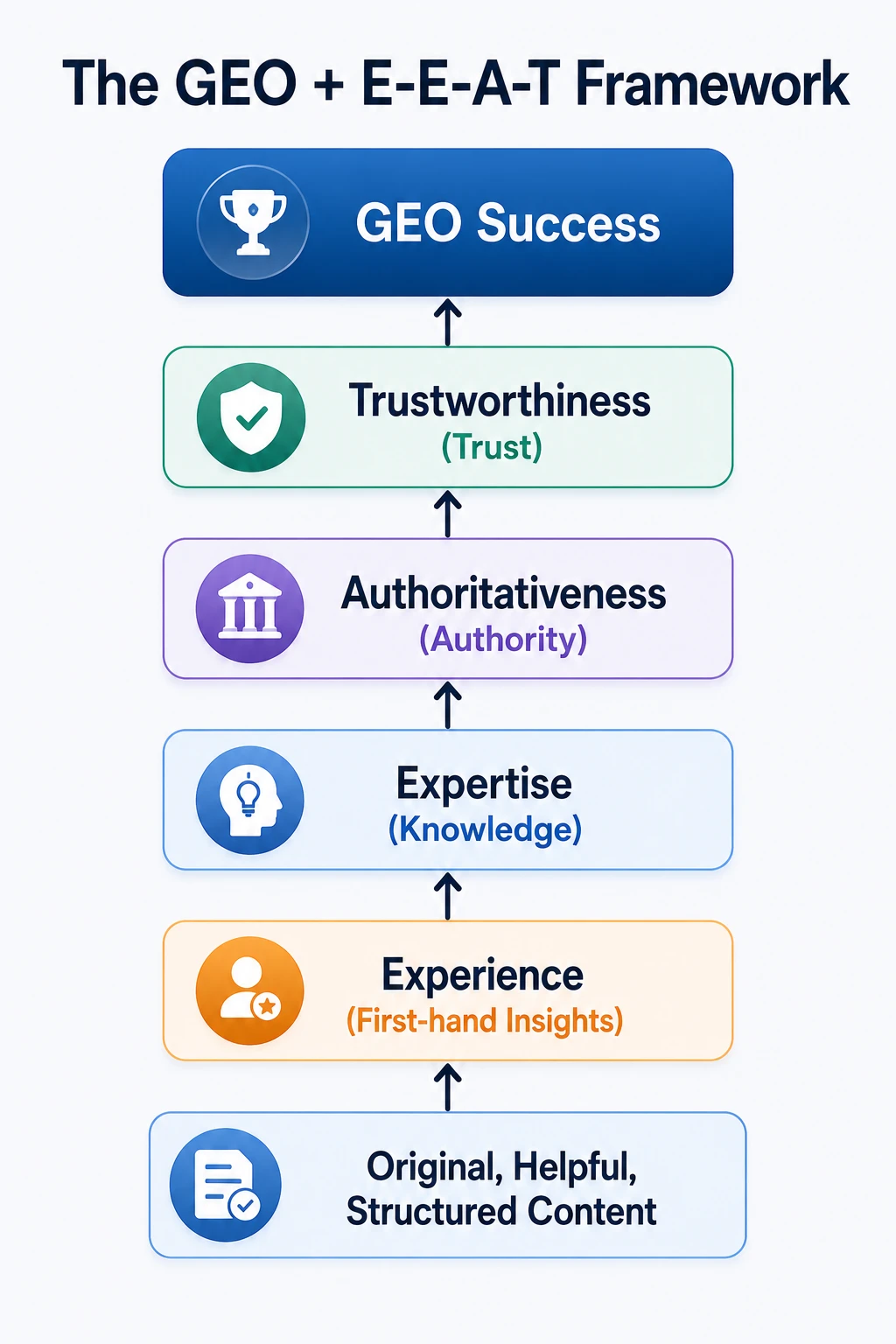
The most successful brands don’t just create content; they create credible, experience-driven resources that AI systems can confidently reference.
A simple way to think about it is:
“High-Quality Content + Strong E-E-A-T Signals + Clear Structure + Consistent Brand Authority = Better Potential for AI Visibility”
In other words, don’t create content just to rank on search engines. Create content that demonstrates genuine expertise, provides unique value, and earns enough trust to become a source that both users and AI systems rely on.
How to Audit Your Brand’s AI Visibility
Unlike traditional SEO, there isn’t a single dashboard that tells you how visible your brand is across AI platforms.
However, you can build a practical framework to evaluate your current position.
Step 1: Test Relevant Prompts
Start by identifying the questions your target audience is likely to ask.
For example:
- Best digital marketing agencies in India
- Top SEO companies for startups
- Best CRM for small businesses
- Best accounting software for MSMEs
- Top performance marketing agencies
Run these prompts across multiple AI platforms, including ChatGPT, Gemini, Perplexity, and Google AI Overviews.
Record whether your brand appears and how it is described.
Step 2: Compare Against Competitors
Evaluate:
- Which competitors are mentioned?
- How frequently are they recommended?
- What differentiators are highlighted?
- Which websites or publications are cited?
This helps identify authority gaps and opportunities.
Step 3: Review Your Brand Signals
Check whether your messaging is consistent across:
- Website
- Google Business Profile
- Social media
- Review platforms
- Business directories
AI systems are more likely to trust brands with consistent information across multiple sources.
Step 4: Evaluate Your Content
Ask yourself:
- Does the content answer real user questions?
- Is it well structured?
- Is it easy to scan?
- Does it demonstrate expertise?
- Is it updated regularly?
High-quality content is more likely to be referenced by AI systems.
Step 5: Monitor Progress
Repeat these prompt tests every month and maintain an internal AI visibility tracker that includes:
- Prompt tested
- AI platform
- Whether your brand appeared
- Position within the answer
- Competitors mentioned
- Source citations
- Key observations
Over time, this provides a practical benchmark for measuring GEO improvements.
How to Measure GEO Success
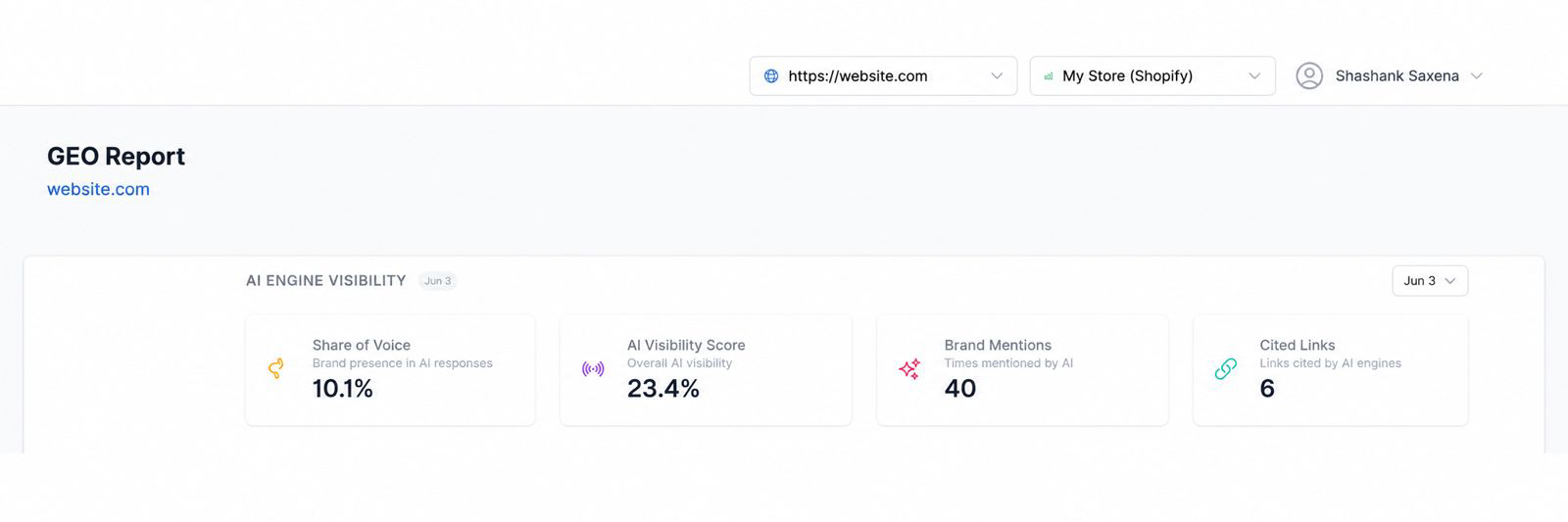
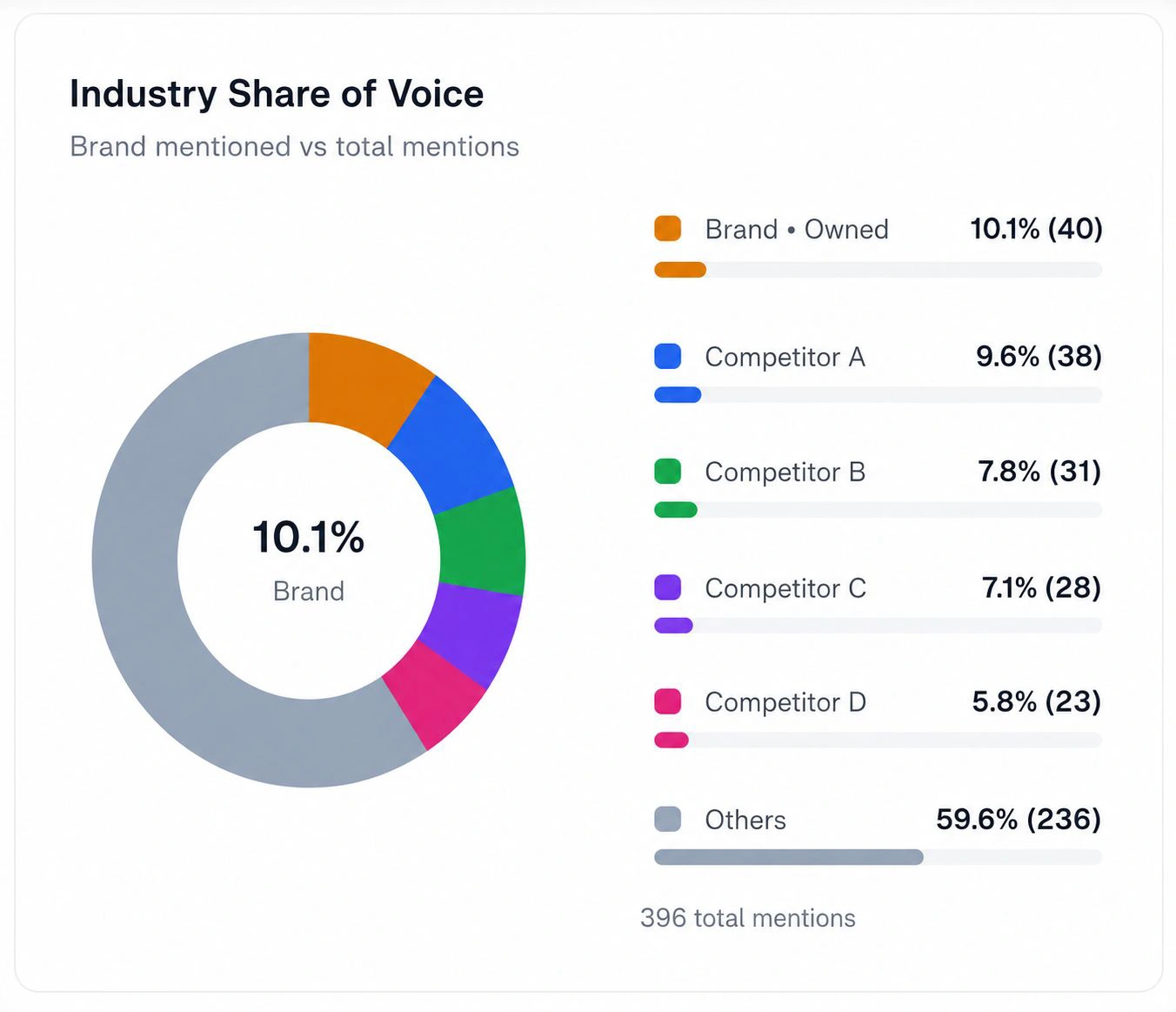
Unlike traditional SEO, GEO doesn’t have one universal metric.
Instead, monitor indicators such as:
| Metric | What It Measures | Why It Matters |
| AI Mentions | How often AI platforms mention your brand | Indicates AI visibility |
| AI Citations | How often your content is referenced as a source | Reflects credibility |
| Share of Voice | Your visibility compared to competitors | Measures market presence |
| Branded Searches | Searches for your brand name | Shows growing awareness |
| Referral Traffic | Visits from AI platforms and third-party sources | Measures discovery |
| Direct Traffic | Users who come directly to your website | Indicates brand recall |
| Engagement | Time on page, interactions, conversions | Measures content usefulness |
| Brand Sentiment | How your brand is discussed online | Builds trust and authority |
| Third-Party Mentions | PR, blogs, Reddit, LinkedIn, forums | Strengthens entity signals |
| Prompt Coverage | Percentage of tested AI prompts where your brand appears | One of the most practical GEO KPIs |
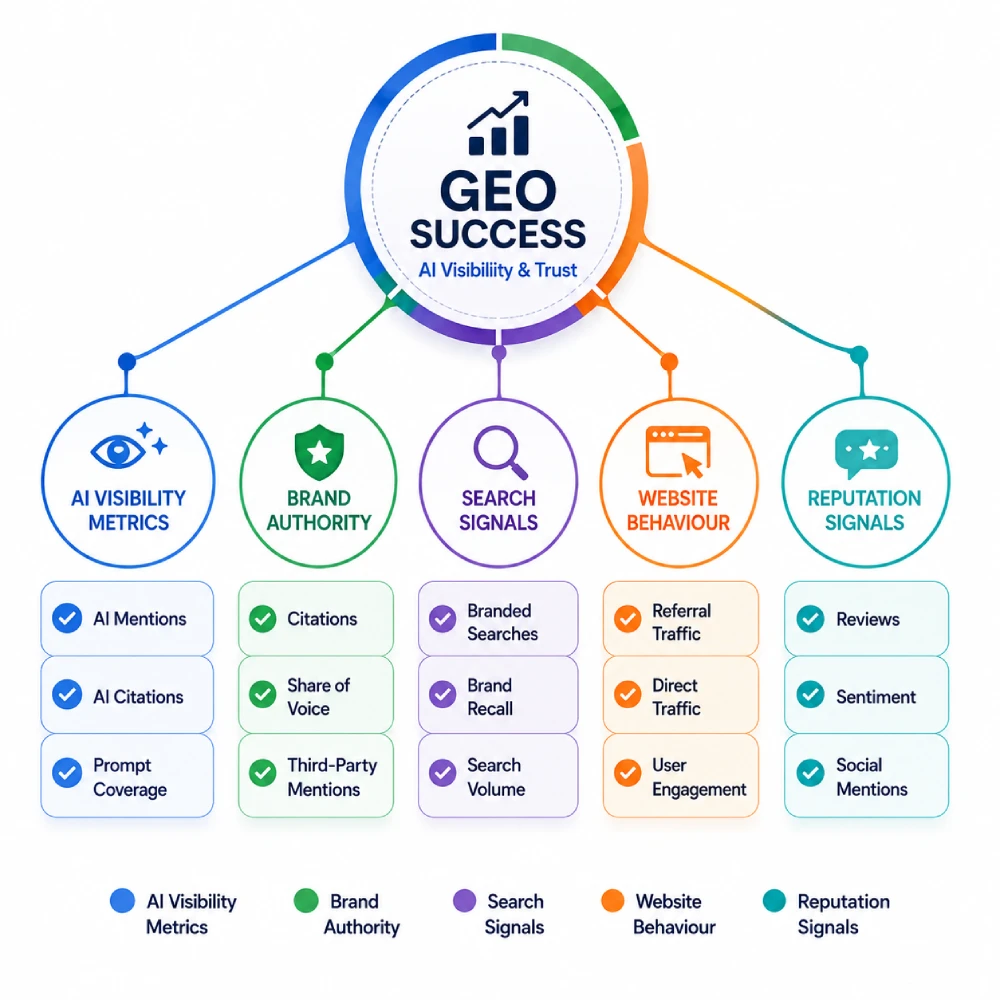
As AI search evolves, measurement frameworks will continue to improve.
A Simple GEO Checklist
Before publishing content, ask yourself:
- Is the content accurate?
- Does it answer a real user question?
- Is it easy to scan?
- Does it use clear headings?
- Do credible sources support the information?
- Does it demonstrate expertise?
- Is the brand information consistent?
- Is structured data implemented?
- Is the content regularly updated?
- Does it add unique value?
If the answer is yes, you’re already moving in the right direction.
The Future of GEO
The way people search is evolving rapidly.
AI assistants are becoming:
- shopping assistants
- research assistants
- travel planners
- coding partners
- healthcare information guides
- business advisors
As conversational search becomes more common, businesses won’t just compete for rankings – they will compete for recommendations.
The brands that consistently publish trustworthy, structured, and useful information will be better positioned for long-term visibility.
Final Thoughts
Generative Engine Optimization isn’t a replacement for SEO.
It’s the natural evolution of search in an AI-first world.
Businesses that combine strong technical SEO, high-quality content, topical authority, and brand credibility will be better positioned to appear in both traditional search results and AI-generated answers.
Rather than chasing algorithms, focus on becoming the most reliable source of information in your niche.
That’s good SEO.
And it’s good GEO too.
Frequently Asked Questions
Is GEO replacing SEO?
No. GEO is an extension of traditional SEO, not a replacement. While SEO focuses on improving rankings and organic traffic, GEO helps your brand become more visible in AI-generated answers and recommendations. A strong SEO foundation remains essential for effective GEO.
Can AI tools like ChatGPT recommend my business?
Yes, but there are no guaranteed shortcuts. Businesses with high-quality content, strong topical authority, consistent brand signals, and credible mentions across the web are more likely to be referenced or recommended by AI platforms.
Does structured data help with GEO?
Structured data helps search engines and AI systems better understand your content and its context. While it doesn’t guarantee AI citations, it improves machine readability and supports better content interpretation, making it an important GEO best practice.
Can small businesses benefit from GEO?
Absolutely. Small businesses can compete effectively by focusing on niche expertise, publishing valuable content, and building trust within their industry. AI systems often prioritise relevance and credibility over brand size alone.
What type of content is most likely to be cited by AI?
Content that is clear, well-structured, EEAT followed and genuinely helpful has the best chance of being cited. Detailed guides, FAQs, comparison articles, case studies, original research, and data-backed content are particularly effective because they directly answer user questions and demonstrate expertise.
Can Social Panga help my business improve its visibility in AI search?
Yes. At Social Panga, we take a holistic approach to Generative Engine Optimization (GEO) by combining technical SEO, content strategy, entity optimization, digital PR, and brand authority building. Our goal is to help brands become more discoverable and more likely to be referenced across AI-powered search experiences such as ChatGPT, Google AI Overviews, Gemini, and Perplexity.
How is Social Panga’s approach to GEO different from traditional SEO?
Traditional SEO primarily focuses on improving rankings and driving organic traffic from search engines. Our GEO approach goes beyond rankings by helping brands build topical authority, strengthen entity signals, create AI-friendly content, and increase their visibility across AI-generated answers and recommendation engines.
How can I get started with GEO for my business?
The best place to start is with a GEO audit. We evaluate your current AI visibility, content quality, technical foundations, brand authority, and competitive landscape to identify opportunities for improvement. Based on these insights, we create a tailored roadmap to help your business strengthen its presence across both traditional search engines and AI-powered platforms.
Ready to Future-Proof Your Brand for AI Search?
AI-powered search is changing how people discover businesses, products, and services. The brands that invest in GEO today will be better positioned to earn visibility and trust tomorrow.
Whether you’re looking to audit your AI presence, build topical authority, or create an end-to-end GEO strategy, Social Panga can help you navigate the next evolution of search.
Get in touch with our team for a GEO consultation and discover how your brand can stand out in the age of AI.


